
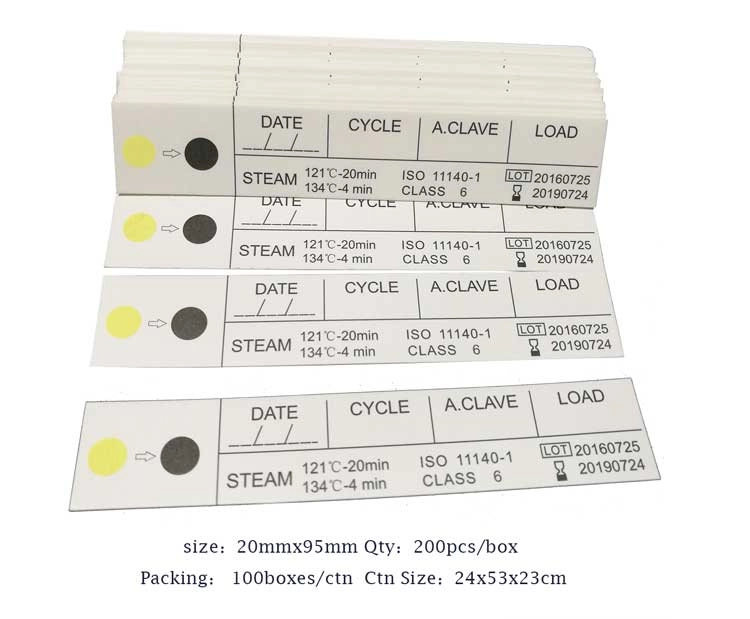

SKU 57853

A Class 6 Chemical Indicator, often referred to as a Type 6 Chemical Indicator, is a specialized tool used in the control and monitoring of steam sterilization processes. These indicators play a crucial role in ensuring the effectiveness of the sterilization of medical instruments, equipment, and supplies.
Characteristics
Process
—
Steam
Chemical Indicator Type
—
Type 6
Indicator Type
—
Type 6 Chemical Indicator
Quantity in box
—
200 strips
Packaging
—
200 strips
Distributor, OEM and private-label pricing is available upon request. Final pricing may vary depending on market region, order volume, packaging configuration, shelf-life requirement, documentation package and Incoterms.
#PROP_TITLE#
—
#PROP_VALUE#
Purpose: Class 6 Chemical Indicators are designed to provide a visual or chemical signal that verifies whether the sterilization process has reached the required conditions to effectively kill or inactivate harmful microorganisms. Conditions include specific temperature (our indicators can designing for T between 90C and 140C), time can adjust between 30 sec and 60 min) and pressure parameters.
Monitoring Sterilization: When placed with the items to be sterilized, Class 6 Chemical Indicators undergo a distinct and visible change when exposed to the sterilization conditions. This change acts as an immediate visual confirmation that the sterilization process has occurred as expected.
Types: Class 6 Chemical Indicators come in various forms, such as strips, labels, or tapes. They are usually affixed to or placed inside packages or containers of items to be sterilized.
Parameters Monitored: These indicators are specifically designed to monitor critical parameters like temperature and, in the case of steam sterilization, humidity or steam penetration (121/15 min, 134C/3.5 min/. For steam sterilization, they change color to blue.
Routine Use: Class 6 Chemical Indicators are routinely employed in healthcare facilities, laboratories, and other environments where sterilization is crucial to ensure the safety of patients, healthcare workers, and researchers.
Complementing Biological Indicators: While Class 6 Chemical Indicators offer immediate feedback on the sterilization process, they are often used in conjunction with biological indicators, which involve the use of living organisms like spores to validate the effectiveness of sterilization. Biological indicators provide more comprehensive and time-consuming validation.
Compliance and Safety: The use of Class 6 Chemical Indicators is often a requirement to comply with regulatory standards and guidelines in healthcare settings. It helps ensure the safety of patients and the integrity of medical equipment and instruments.
Class 6 Chemical Indicators are essential tools for confirming that items have undergone effective sterilization. Their visual or chemical changes serve as immediate feedback to healthcare professionals, indicating that sterilization conditions have been met, and the items are safe for use in medical procedures or research. These indicators play a critical role in infection control and patient safety.
Monitoring Sterilization: When placed with the items to be sterilized, Class 6 Chemical Indicators undergo a distinct and visible change when exposed to the sterilization conditions. This change acts as an immediate visual confirmation that the sterilization process has occurred as expected.
Types: Class 6 Chemical Indicators come in various forms, such as strips, labels, or tapes. They are usually affixed to or placed inside packages or containers of items to be sterilized.
Parameters Monitored: These indicators are specifically designed to monitor critical parameters like temperature and, in the case of steam sterilization, humidity or steam penetration (121/15 min, 134C/3.5 min/. For steam sterilization, they change color to blue.
Routine Use: Class 6 Chemical Indicators are routinely employed in healthcare facilities, laboratories, and other environments where sterilization is crucial to ensure the safety of patients, healthcare workers, and researchers.
Complementing Biological Indicators: While Class 6 Chemical Indicators offer immediate feedback on the sterilization process, they are often used in conjunction with biological indicators, which involve the use of living organisms like spores to validate the effectiveness of sterilization. Biological indicators provide more comprehensive and time-consuming validation.
Compliance and Safety: The use of Class 6 Chemical Indicators is often a requirement to comply with regulatory standards and guidelines in healthcare settings. It helps ensure the safety of patients and the integrity of medical equipment and instruments.
Class 6 Chemical Indicators are essential tools for confirming that items have undergone effective sterilization. Their visual or chemical changes serve as immediate feedback to healthcare professionals, indicating that sterilization conditions have been met, and the items are safe for use in medical procedures or research. These indicators play a critical role in infection control and patient safety.
Articles
Sterilization indicators
3 July 2026
Introducing Class 6 Indicators: Ensuring Safety and Sterility in Sterilization Processes
Sterilization is crucial in industries like healthcare and pharmaceuticals, and chemical indicators play a pivotal role in ensuring its effectiveness. Discover the world of class 6 indicators, the gold standard for monitoring steam sterilization processes. These indicators provide visual confirmation that sterilization conditions have been met, offering peace of mind and patient safety.
But what sets class 6 indicators apart? They are designed to meet strict industry standards and regulatory requirements, ensuring compliance with sterilization guidelines. By using class 6 indicators, healthcare facilities can optimize their sterilization processes, identify deviations early on, and make necessary adjustments.
To maximize their effectiveness, proper placement and regular monitoring are essential. And while class 6 indicators offer a high level of assurance, they should be used alongside other monitoring methods for comprehensive sterilization validation.
Sterilization is crucial in industries like healthcare and pharmaceuticals, and chemical indicators play a pivotal role in ensuring its effectiveness. Discover the world of class 6 indicators, the gold standard for monitoring steam sterilization processes. These indicators provide visual confirmation that sterilization conditions have been met, offering peace of mind and patient safety.
But what sets class 6 indicators apart? They are designed to meet strict industry standards and regulatory requirements, ensuring compliance with sterilization guidelines. By using class 6 indicators, healthcare facilities can optimize their sterilization processes, identify deviations early on, and make necessary adjustments.
To maximize their effectiveness, proper placement and regular monitoring are essential. And while class 6 indicators offer a high level of assurance, they should be used alongside other monitoring methods for comprehensive sterilization validation.
Sterilization indicators
21 March 2023
The chemical indicators or indicator systems described in this part of ISO 11140 The six indicator types described in the main body of this part of ISO 11140 are categorized according to their performance requirements. The chemical indicators within each of these categorizations are further subdivided by the sterilization process for which they are designed to be used. These categorizations have no hierarchical significance. Attainment of the chemical indicator’s end point should not be regarded as an indication of attainment of an acceptable sterility assurance level, but rather one of many factors which should be taken into consideration when judging the acceptability of a sterilization process.
Sterilization indicators
4 April 2022
Chemical indicators are tools used in sterilization processes to verify that a set of predetermined conditions has been achieved within a sterilization cycle. They work through a visible change, usually a change in color, that occurs in response to exposure to physical conditions such as temperature, time, and steam. In the realm of sterilization, chemical indicators are invaluable, but they are not all made equal. Here is an overview of the different types of chemical indicators.
Sterilization indicators
14 February 2021
Class 6 Chemical Indicators are essential devices used to measure the effectiveness of sterilization processes in medical applications. They generally consist of an absorbent pad, paper strip or test pack containing one or more chemicals that change color when exposed to heat, steam and other gases. Common types include Bowie Dick tests, biological indicators (BI) and physical/chemical indicators (PCI). Class 6 chemical indicators provide real-time data about how effective sterilization systems are at destroying harmful pathogens without relying solely on manual inspection methods - reducing potential risk from contamination caused by human error.
Sterilization indicators
14 February 2021
Indicators are strips of film and heat-resistant paper, they show whether sterilization has been carried out correctly or not. In the case of steam sterilization, indicators control the temperature, the period of its exposure, the saturation of water vapor; with the air method - the temperature and the duration of its exposure. The indicator has a marking and two colored marks, one of which is an indicator, and the other is a comparison standard.
RELATED PRODUCTS
#PROP_TITLE#
#PROP_VALUE#