

Classification of Medical Masks
Medical masks are used to help reduce exposure to droplets, splashes, particles and other contaminants in healthcare, laboratory, industrial and public-use environments. Depending on their design and filtration performance, masks may be used for source control, basic barrier protection, surgical procedures or respiratory protection.
The correct mask type should be selected according to the intended application, risk level, applicable standards and the manufacturer’s instructions for use.
A Brief History of Medical Masks
Early forms of face protection were used by physicians during historical epidemics, including plague-era protective masks. Modern medical masks became widely adopted in the early 20th century, especially during outbreaks of respiratory disease. Later, disposable masks made from nonwoven materials became common in healthcare and public health settings.
Today, medical masks and respirators are available in multiple designs, including disposable surgical masks, procedure masks, fabric masks and filtering facepiece respirators.
Main Classification of Medical Masks
Medical and protective masks can be classified by user group, sterility, intended use, material and filtration performance.
- By size: adult masks and children’s masks.
- By sterility: sterile and non-sterile masks.
- By use: procedure masks, surgical masks, protective masks and respirators.
- By material: nonwoven disposable masks, fabric masks, gauze masks and respirators with filter media.
- By protection level: basic barrier masks, surgical masks and certified respirators such as FFP1, FFP2 or FFP3.
Types of Medical Masks
Disposable Procedure Masks
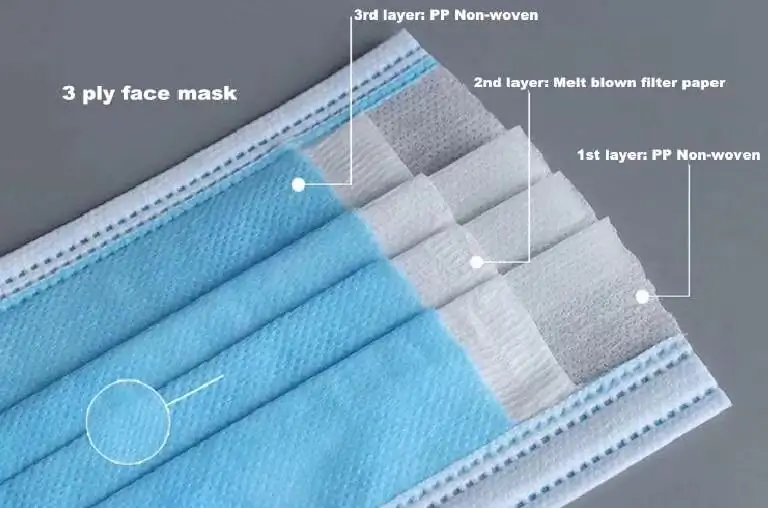
Disposable procedure masks are commonly made from multiple layers of nonwoven material. They usually include ear loops, a nose strip and a pleated structure that helps the mask fit the face more comfortably.
These masks are widely used in clinics, laboratories, dental practices and general healthcare environments for routine barrier protection and source control.
Surgical Masks
Surgical masks are designed for use in medical procedures where protection against droplets, splashes and biological fluids may be required. Compared with ordinary procedure masks, surgical masks may include additional barrier layers and must meet relevant performance requirements for their intended market.
They are commonly used by surgeons, nurses, dental professionals and other healthcare workers during procedures.
Fabric or Gauze Masks
Fabric or gauze masks are reusable face coverings made from woven or knitted textile materials. They may help reduce the spread of large respiratory droplets in low-risk public-use situations, depending on their construction and fit.
However, fabric masks are not equivalent to certified medical masks or respirators and should not be used as a substitute for professional protective equipment in high-risk healthcare environments.
Activated Carbon Masks
Activated carbon masks contain an additional carbon filter layer designed to help reduce certain odours and selected airborne particles. They may be used in environments with dust, odours or light pollution, depending on the product design.
Their performance depends on the filter structure, fit and applicable test standards.
Respirators
Respirators are designed to provide a higher level of filtration and facial fit than ordinary masks. Common European filtering facepiece classes include FFP1, FFP2 and FFP3.
- FFP1: basic particle filtration for low-risk dust environments.
- FFP2: higher filtration performance, commonly used where improved respiratory protection is required.
- FFP3: the highest filtration class in the FFP category, used for higher-risk particle exposure when properly fitted and used.
Respirators should be selected and used according to applicable occupational safety requirements, fit testing procedures and the manufacturer’s instructions.
How to Choose the Right Mask
The best mask type depends on the intended use and exposure risk. For general public use, a basic disposable or fabric mask may be sufficient in low-risk situations. For medical procedures, surgical masks or certified medical masks are usually required. For higher-risk respiratory exposure, a certified respirator may be necessary.
- For daily general use: disposable procedure masks or suitable fabric masks may be used according to local guidance.
- For healthcare and dental work: medical or surgical masks should be selected according to procedure risk.
- For exposure to fine particles or hazardous aerosols: certified respirators such as FFP2 or FFP3 may be required.
- For splash risk: masks may be used together with eye protection or face shields.
Conclusion
Medical masks, procedure masks, surgical masks and respirators serve different purposes. Their performance depends on material, filtration efficiency, fit, fluid resistance and correct use. Choosing the right mask helps support infection control, workplace safety and respiratory protection according to the intended application.
Mediwish supplies disposable medical masks, protective masks and related medical consumables for healthcare, dental, laboratory and general protection applications.